
Our Role in Emotional Resilience
By Erica Parrish | May 2026
 As school counselors, nurturing the students we serve is both our role and our responsibility. We do this through the curriculum we deliver, the behaviors we model and the skills we intentionally reinforce. Each day, we are met with challenging stories and behaviors, and often ask ourselves, “How do I empower this student to move through this?” This question sits at the heart of our work and is a big reason many of us chose this field.
The ASCA Ethical Standards and the ASCA Mindsets & Behaviors help us ensure our practices are not only best practice, but grounded in our professional and ethical responsibility (A.1).
Resilience is the ability to bounce back when life gets hard. Many students have not yet cultivated this skill. In Montana, we often hear the phrase “cowboy up” – push through, tough it out – but what does that really mean? When we break down the skills necessary to develop resilience, it is more than just grit. It requires emotional regulation, healthy coping skills, perseverance, adaptability and the ability to seek support (B-SMS 2; B-SMS 7). These are not traits someone is simply born with; they are skills that must be intentionally taught and practiced.
As we recognize that we are already engaging in practices that shape resilient students, the question becomes: How do we do this more intentionally? Nurturing is the process of caring for and encouraging growth and development. Within our ethical responsibilities and the ASCA Mindsets and Behaviors, nurturing is embedded in our role as school counselors (A.1; A.5; M 1; M 2). The lessons we design and the interventions we implement are, by definition, efforts to cultivate emotionally resilient students.
We nurture resilience through relationships. Before any skill can be taught, students must feel safe, seen, and valued. This means creating environments where students can show up authentically (A.2). It is active listening, validating emotions and showing up as a trusted adult. When students feel safe, they are more willing to take risks, reflect and grow (M 3; B-SS 2).
We also nurture resilience through explicit instruction. Social/emotional learning is essential and can be taught and reinforced. Whether through classroom lessons or small groups, these skills can be broken down and practiced. We help students identify emotions, understand triggers, use grounding techniques and reframe thoughts (B-SMS 7). We normalize struggle and provide language to express emotions while giving students opportunities to practice in supportive environments.
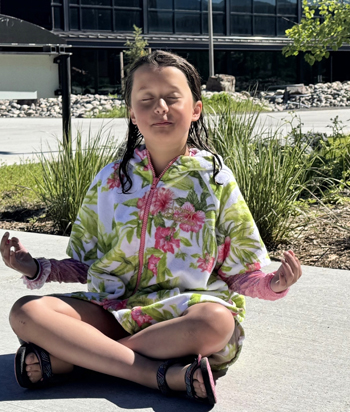 Modeling is another powerful form of nurturing. By demonstrating problem solving, self-awareness and help seeking, we provide a blueprint for resilience (B-SMS 5). Even simple actions like reframing failure as feedback, or acknowledging effort over outcome can shift what students believe about themselves and contribute to lower rates of anxiety and depression. In my own life, I try to model this with my children, and I’ll be honest: it can be challenging. As adults, we often feel pressure to appear strong, but there is power in showing that it is okay to feel, struggle and work through it. It gives students permission to do the same. (In photo, Erica’s 9-year-old daughter practices mindfulness that was taught/modeled by her school counselor, Marie Welch, at Gallatin Gateway School and Montana Mindfulness Project.)
Nurturing resilience also means creating opportunities for both challenge and support. We allow students to experience growth without removing the obstacles in front of them. Rather than rescuing students, we guide them through difficulty. We may need to remind ourselves that we do not have to be fixers. This approach allows students to reflect, adjust and try again, ultimately fostering empowerment (A.4; B-LS 4). At the same time, we teach that resilience includes knowing when and how to seek support. By normalizing help seeking, connecting students to resources and fostering peer relationships, we strengthen their sense of belonging (B-SS 8; A.5).
This work is reinforced through intentional reflection. When we encourage students to recognize their growth – what they learned, what supported them and how they will approach future challenges – they begin to internalize their strengths and build confidence in their ability to navigate adversity (B-LS 1; M 1).
As we continue to do this work, I encourage you to approach it through a lens of nurturing and to view resilience as an ongoing lesson. Each intentional interaction, lesson or conversation is an opportunity to build relationships and contribute to a student’s resilience. As school counselors, when we look beyond the immediate crisis and invest in students’ long-term growth, we empower them with the skills they need to persevere.
Contact Erica Parrish, a member of the MSCA Board of Directors, at erica@elm-coaching.com.