
President's Letter: Our Role in Resilience
By Mark Mason | September 2021
Welcome back, New York school counselors.
 I hope that each of you has taken some time to rest, unwind and rejuvenate. As our students return, they will be looking forward to seeing each of you. It might be through a mask, but it will be to have each of us embrace them with care and attention. Whether a student has been behind the computer or a plastic shield, the student wants to know that each school counselor in the state of New York is there to protect and support them. During this pandemic, each student has faced an individual challenge. It is important for us to use the special skills that we, and only we, have to make them strong, successful members of the community. Many school counselors may choose to use multitiered systems of support (MTSS) as a way to focus social/emotional learning (SEL) and build resilience back into their everyday life.
How would you describe the characteristics of an individual most likely to succeed? Most people would respond to this question with words and phrases such as goal-directed, self-motivated, self-directed, able to cope with life, self-confident, likable, cheerful, persistent, independent, creative, optimistic, good at communicating and self-disciplined. I am sure you will agree that this is a lengthy list, but all of these traits can be summed up in one general characteristic: resilience. Teaching resilience to children can help increase learning in the classroom through hands-on learning. As school counselors, we have a duty and moral obligation to make sure that each of the students we have been charged to support will be supported through the use of SEL. This will ensure that their mental health is ready to sustain the academic knowledge that our teaching colleagues will share with them.
A study done for the state of New York discussed how students whose teachers emphasize higher order thinking skills and hands-on learning activities outperformed their peers significantly. Students who were engaged in hands-on learning on a weekly basis outperformed those who engaged in this instruction approach on a monthly basis. Students whose teachers conduct hands-on learning activities outperform their peers by 72 percent of a grade level in math and 40 percent of a grade level in science. If hands-on learning is the best way to teach students, then I feel school counselors should develop a resource toolkit of group dynamic activities that teach students lessons and develop a higher level of resiliency skills. We hope that you will visit NYSED’s SEL Resource webpage to access many ideas for providing SEL lessons and activities.
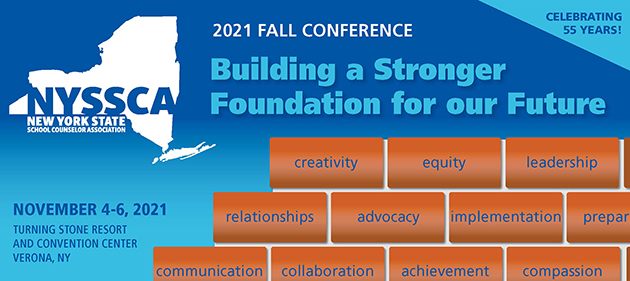
I look forward to NYSSCA’s continued support of your work throughout the year and I am confident of your success through this work. I hope to see each of you at the fall conference, November 4–6 at Turning Stone Resort.
Contact Mark Mason, NYSSCA president, at president@nyssca.org.
.jpg)
I hope that each of you has taken some time to rest, unwind and rejuvenate. As our students return, they will be looking forward to seeing each of you. It might be through a mask, but it will be to have each of us embrace them with care and attention. Whether a student has been behind the computer or a plastic shield, the student wants to know that each school counselor in the state of New York is there to protect and support them. During this pandemic, each student has faced an individual challenge. It is important for us to use the special skills that we, and only we, have to make them strong, successful members of the community. Many school counselors may choose to use multitiered systems of support (MTSS) as a way to focus social/emotional learning (SEL) and build resilience back into their everyday life.How would you describe the characteristics of an individual most likely to succeed? Most people would respond to this question with words and phrases such as goal-directed, self-motivated, self-directed, able to cope with life, self-confident, likable, cheerful, persistent, independent, creative, optimistic, good at communicating and self-disciplined. I am sure you will agree that this is a lengthy list, but all of these traits can be summed up in one general characteristic: resilience. Teaching resilience to children can help increase learning in the classroom through hands-on learning. As school counselors, we have a duty and moral obligation to make sure that each of the students we have been charged to support will be supported through the use of SEL. This will ensure that their mental health is ready to sustain the academic knowledge that our teaching colleagues will share with them.
A study done for the state of New York discussed how students whose teachers emphasize higher order thinking skills and hands-on learning activities outperformed their peers significantly. Students who were engaged in hands-on learning on a weekly basis outperformed those who engaged in this instruction approach on a monthly basis. Students whose teachers conduct hands-on learning activities outperform their peers by 72 percent of a grade level in math and 40 percent of a grade level in science. If hands-on learning is the best way to teach students, then I feel school counselors should develop a resource toolkit of group dynamic activities that teach students lessons and develop a higher level of resiliency skills. We hope that you will visit NYSED’s SEL Resource webpage to access many ideas for providing SEL lessons and activities.
I look forward to NYSSCA’s continued support of your work throughout the year and I am confident of your success through this work. I hope to see each of you at the fall conference, November 4–6 at Turning Stone Resort.
Contact Mark Mason, NYSSCA president, at president@nyssca.org.