
Minute Meetings: Amplifying Student Voice
By Laura Rankhorn and Kim Crumbley | January 2026
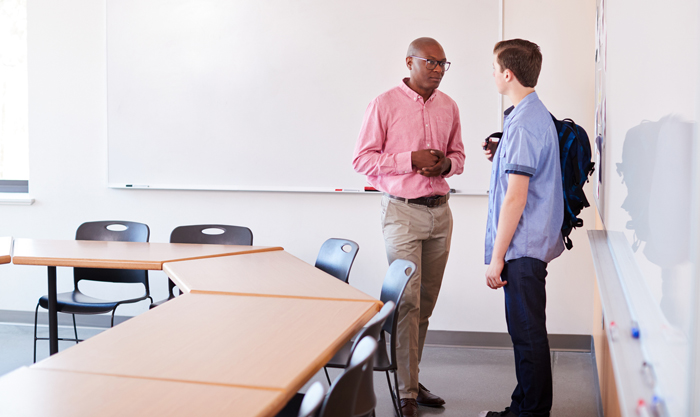
If you’ve been a school counselor for two days or more, there’s a strong chance you’ve already met what we call the frequent flyer. This is the student who self-refers because he remembered that his parents once had a goldfish that died before he was born, and now he’s sad about it.
Frequent flyers have real needs and deserve care. But a few years ago, we realized something unsettling: The squeaky wheels were getting all the oil. The same students were receiving the bulk of our time and attention through responsive services. And that left us asking a question that almost paralyzed us with fear: Who else needs us but isn’t asking? Proving our fear, at times Child Protective Services called about students in heartbreaking situations that we knew nothing about.
Our time was also being consumed by new student enrollments, 504 requests, special education referrals, testing responsibilities, lunch duty, students running from class, crisis response, etc. The authors of “Making MTSS Work” said it best: “As a result of a multitude of competing responsibilities, school counselors may find themselves reactively responding to crises and demands, rather than purposefully and proactively planning and implementing school counseling programs.”
That quote hit us like a mirror. We weren’t planning. We were responding. We weren’t preventing. We were waiting for the next emergency. And that led us to ask:
The first year we implemented Minute Meetings, we noticed a shift from reactive to proactive. But what surprised us most was that minute meetings became a powerful platform for student voice.
For the first time, every student – not just the ones with referrals, discipline issues or visible struggles – had intentional space to be heard. And when given space, students speak.
We began hearing things discipline reports, grade reports, or referrals don’t say:
Instead of us deciding who needed support based on behaviors and referrals, students told us in their own words what was happening in their lives. Their voices began shaping school-wide supports.
We exported names from our student database into a spreadsheet. We pasted our questions at the top. As students answered, we highlighted anything that stood out for follow-up.
Questions that have powerfully amplified student voice include:
Minute Meetings moved our school counseling programs from hearing the loudest voices to hearing every voice. Students now know that there is space for them, their experiences matter and their stories help shape the support they receive. And that may be the most powerful outcome of all.
Laura Rankhorn is a middle school counselor at Good Hope Middle School in Cullman, Ala. Contact her at lrankhorn@ccboe.org. Kim Crumbley Is a pre-K–8 counselor at Parkside School in Baileyton, Ala. Contact her at kcrumbley@ccboe.org.
Frequent flyers have real needs and deserve care. But a few years ago, we realized something unsettling: The squeaky wheels were getting all the oil. The same students were receiving the bulk of our time and attention through responsive services. And that left us asking a question that almost paralyzed us with fear: Who else needs us but isn’t asking? Proving our fear, at times Child Protective Services called about students in heartbreaking situations that we knew nothing about.
Our time was also being consumed by new student enrollments, 504 requests, special education referrals, testing responsibilities, lunch duty, students running from class, crisis response, etc. The authors of “Making MTSS Work” said it best: “As a result of a multitude of competing responsibilities, school counselors may find themselves reactively responding to crises and demands, rather than purposefully and proactively planning and implementing school counseling programs.”
That quote hit us like a mirror. We weren’t planning. We were responding. We weren’t preventing. We were waiting for the next emergency. And that led us to ask:
- What if there were a way to uncover student needs before they became crises?
- What if every student, not just the loudest, had space to be heard?
The first year we implemented Minute Meetings, we noticed a shift from reactive to proactive. But what surprised us most was that minute meetings became a powerful platform for student voice.
For the first time, every student – not just the ones with referrals, discipline issues or visible struggles – had intentional space to be heard. And when given space, students speak.
We began hearing things discipline reports, grade reports, or referrals don’t say:
- “I eat lunch alone every day and act like I like it.”
- “I make good grades, but I go home and take care of my siblings every night.”
- “I smile, but I feel anxious all the time.”
Instead of us deciding who needed support based on behaviors and referrals, students told us in their own words what was happening in their lives. Their voices began shaping school-wide supports.
We exported names from our student database into a spreadsheet. We pasted our questions at the top. As students answered, we highlighted anything that stood out for follow-up.
Questions that have powerfully amplified student voice include:
- “Tell me something you’re afraid of.”
Most answers are snakes and spiders, until you hear, “I’m afraid my whole family will die again.” That student had already lost both parents. - “What is something you wish your teacher knew about you?”
One response still sits heavy with us: “I wish my teacher knew that I try to be good, but sometimes I just can’t.” - “What is a reason you might need to come see me?”
Students have shared sleep issues, bullying, fear at home and anxiety – things they never would have formally referred themselves for. - “What are you really good at?”
This question gives students ownership of their strengths. It also provides powerful motivators for MTSS, positive behavioral interventions and supports and response to intervention meetings. - “What did I not ask that you want me to know?”
This may be the most important student-voice question of them all. Through this question alone, we’ve learned about house fires, lost grandparents, housing instability and hidden trauma – things we never would have known otherwise. - “What would you do differently if you were the teacher, school counselor or principal?”
Yes, we get “free ice cream” and “no homework.” But we also get real insights about school climate, fairness, and student stress.
Minute Meetings moved our school counseling programs from hearing the loudest voices to hearing every voice. Students now know that there is space for them, their experiences matter and their stories help shape the support they receive. And that may be the most powerful outcome of all.
Laura Rankhorn is a middle school counselor at Good Hope Middle School in Cullman, Ala. Contact her at lrankhorn@ccboe.org. Kim Crumbley Is a pre-K–8 counselor at Parkside School in Baileyton, Ala. Contact her at kcrumbley@ccboe.org.