
Supporting Each and Every Student With SEL-Driven Behavior Strategies
By Heather Bushelman | May 2026

The SEL-Driven Behavior Toolbox was a gamechanger for my staff and students. It began when, in a school once filled with smiles and positive tones, teachers became noticeably defeated, exhausted and frustrated, shown in their body language and tone of voice when teaching. School counselors showed the same dysregulation when teaching large group classes. Student behaviors were the cause of this regression in school culture and climate. In any given classroom, a student would be shouting out, another out of her seat, one sleeping, another trying to leave the classroom and one throwing items. Faced with this “whack-a-mole” situation, a teacher or school counselor experiences physical symptoms of escalated stress and worry – headaches, stomachaches, sweating, fatigue, feeling hot or muscles tightening. The adult dysregulation then transfers onto the students, increasing the escalated behaviors.
Across the nation, students’ behaviors have changed due to a variety of factors:
So where do we start? Back to the basics with SEL-driven behavior strategies!
When I was a school counselor, I started noticing the “whack-a-mole” effect as my teachers dealt with increasing unexpected behaviors within the classrooms. As we discussed students who needed additional support, the labeling began: “He has ADHD.” “I had her brother.” “He acts just like his dad.” “She is in special education.” Without realizing it, the educators were tapping out of ownership and admiring the problems versus focusing on solutions. My staff needed a purposeful, easy-to-implement, evidence-based method to decrease unexpected behaviors, a method that would not be just one more training. So I created the SEL-Driven Behavior Toolbox.
I began by consulting with my staff about what the behaviors looked and sounded like in the classroom. From there, I developed a toolbox based on the functions of behavior and SEL skills students are lacking, which then results in the unexpected behaviors. I added easy-to-implement, evidence-based Tier 1 strategies the teachers could try with their students to help decrease the behaviors. I trained my teachers at the beginning of the school year, starting with behavior basics of ensuring they had built a relationship with each and every student in their classroom. I then discussed the difference between performance and acquisition in behavior:
PERFORMANCE:
Is the behavior a choice?
Can the student control their choice/behavior and needs motivation?
ACQUISITION:
Does the student need to be taught expectations?
Is the behavior out of their control? (i.e., trauma based, diagnosis, home factors, etc.)
Once we determined which need the student had, the teachers could use the toolbox to match Tier 1 strategies to the function of behavior and SEL needs. In our training, the teachers used several different student scenarios to practice problem solving with the toolbox. I heard the shift in how they talked about behavior. They were no longer labeling the students, instead but focusing on the “why” of the behavior and what to do about it.
This toolbox became an embedded element within our Tier 1 SEL Implementation throughout the school year, and teachers kept it handy on their desk or wall. If a refresher was needed on a particular strategy, I was happy to coach them how to implement it. Our school saw a decrease in discipline referrals, suspensions and unsafe situations, and an increase in teaching time and teachers’ positive emotional state.
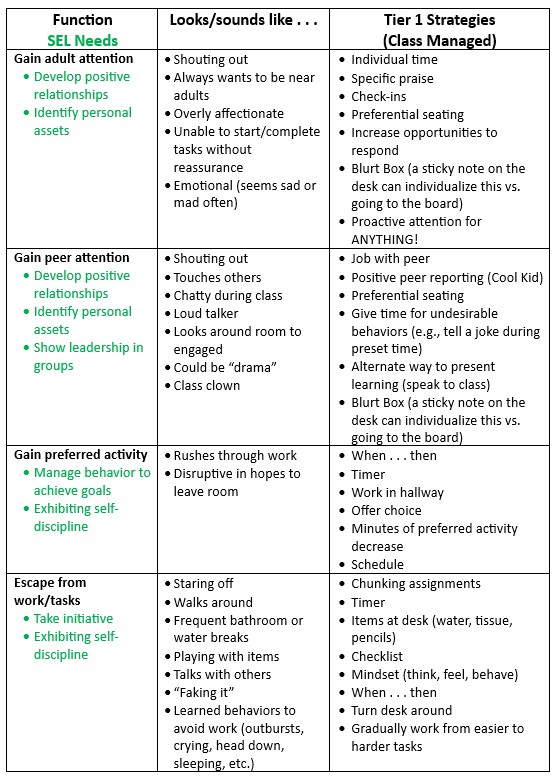
The SEL-Driven Behavior Toolbox made a tremendous difference for my staff and students. So much so that, as a current District MTSS Coordinator, I have every school in my district use a version of the toolbox, preschool through 12th grade. Teachers are now supporting students better because they themselves are better supported with classroom management and problem-solving approaches. We have created a safe, predictable and proactive learning environment that is a positive, SEL-based systemic change for students and staff.
Resources: Heather Bushelman is the district MTSS coordinator for Boone County Schools, Kentucky. Contact her at heather.bushelman@gmail.com.
Across the nation, students’ behaviors have changed due to a variety of factors:
- Trauma of some type – more than two thirds experience this by age 16
- Intense mental health needs
- Increases in unstable home life and family support
- Student negative perceptions of school
- Use of technology as a babysitter
- Little to no prior structured school setting
So where do we start? Back to the basics with SEL-driven behavior strategies!
When I was a school counselor, I started noticing the “whack-a-mole” effect as my teachers dealt with increasing unexpected behaviors within the classrooms. As we discussed students who needed additional support, the labeling began: “He has ADHD.” “I had her brother.” “He acts just like his dad.” “She is in special education.” Without realizing it, the educators were tapping out of ownership and admiring the problems versus focusing on solutions. My staff needed a purposeful, easy-to-implement, evidence-based method to decrease unexpected behaviors, a method that would not be just one more training. So I created the SEL-Driven Behavior Toolbox.
I began by consulting with my staff about what the behaviors looked and sounded like in the classroom. From there, I developed a toolbox based on the functions of behavior and SEL skills students are lacking, which then results in the unexpected behaviors. I added easy-to-implement, evidence-based Tier 1 strategies the teachers could try with their students to help decrease the behaviors. I trained my teachers at the beginning of the school year, starting with behavior basics of ensuring they had built a relationship with each and every student in their classroom. I then discussed the difference between performance and acquisition in behavior:
PERFORMANCE:
Is the behavior a choice?
Can the student control their choice/behavior and needs motivation?
ACQUISITION:
Does the student need to be taught expectations?
Is the behavior out of their control? (i.e., trauma based, diagnosis, home factors, etc.)
Once we determined which need the student had, the teachers could use the toolbox to match Tier 1 strategies to the function of behavior and SEL needs. In our training, the teachers used several different student scenarios to practice problem solving with the toolbox. I heard the shift in how they talked about behavior. They were no longer labeling the students, instead but focusing on the “why” of the behavior and what to do about it.
This toolbox became an embedded element within our Tier 1 SEL Implementation throughout the school year, and teachers kept it handy on their desk or wall. If a refresher was needed on a particular strategy, I was happy to coach them how to implement it. Our school saw a decrease in discipline referrals, suspensions and unsafe situations, and an increase in teaching time and teachers’ positive emotional state.
Resources: Heather Bushelman is the district MTSS coordinator for Boone County Schools, Kentucky. Contact her at heather.bushelman@gmail.com.